Where Small Businesses Lose the Most Time (And Don't Realize It)
Nobody wakes up and says, “I want to spend four hours on emails today.” But that’s exactly what happens. The biggest time drains in a small business aren’t the dramatic fires you put out once a quarter. They’re the quiet, repetitive tasks that eat 15 minutes here, 30 minutes there, every single day, until half your week is gone and you haven’t touched the work that actually grows revenue.
Email is the biggest offender. A McKinsey study found that the average professional spends roughly 28% of their workweek reading, writing, and managing email. For a business owner working 50-hour weeks, that’s 14 hours a week—just on inbox management. Most of those messages are routine: order confirmations, scheduling threads, vendor follow-ups, and status updates that could be handled (or triaged) without you.
Data entry is the second silent killer. Copying invoice numbers into spreadsheets, updating CRM records after a call, logging expenses from receipts. A 2023 Zapier survey found that workers spend an average of 4.5 hours per week on tasks they believe could be automated—and data entry is the most commonly cited candidate. It’s the kind of work that feels quick in the moment but scales terribly as your business grows.
Scheduling is death by a thousand clicks. The back-and-forth of “Does Tuesday work?” and “How about 3pm instead?” can take five or six messages just to book one meeting. Multiply that by 10 meetings a week and you’ve lost hours to a task that AI scheduling tools handle in seconds, automatically checking calendars and sending confirmed invites.
Reporting completes the invisible time tax. Every week, someone on your team pulls numbers from two or three different systems, pastes them into a slide deck or spreadsheet, formats the charts, and sends it out. It takes two to three hours, nobody enjoys it, and by the time it reaches the decision-makers, the data is already a few days old. This entire workflow is a textbook automation win.
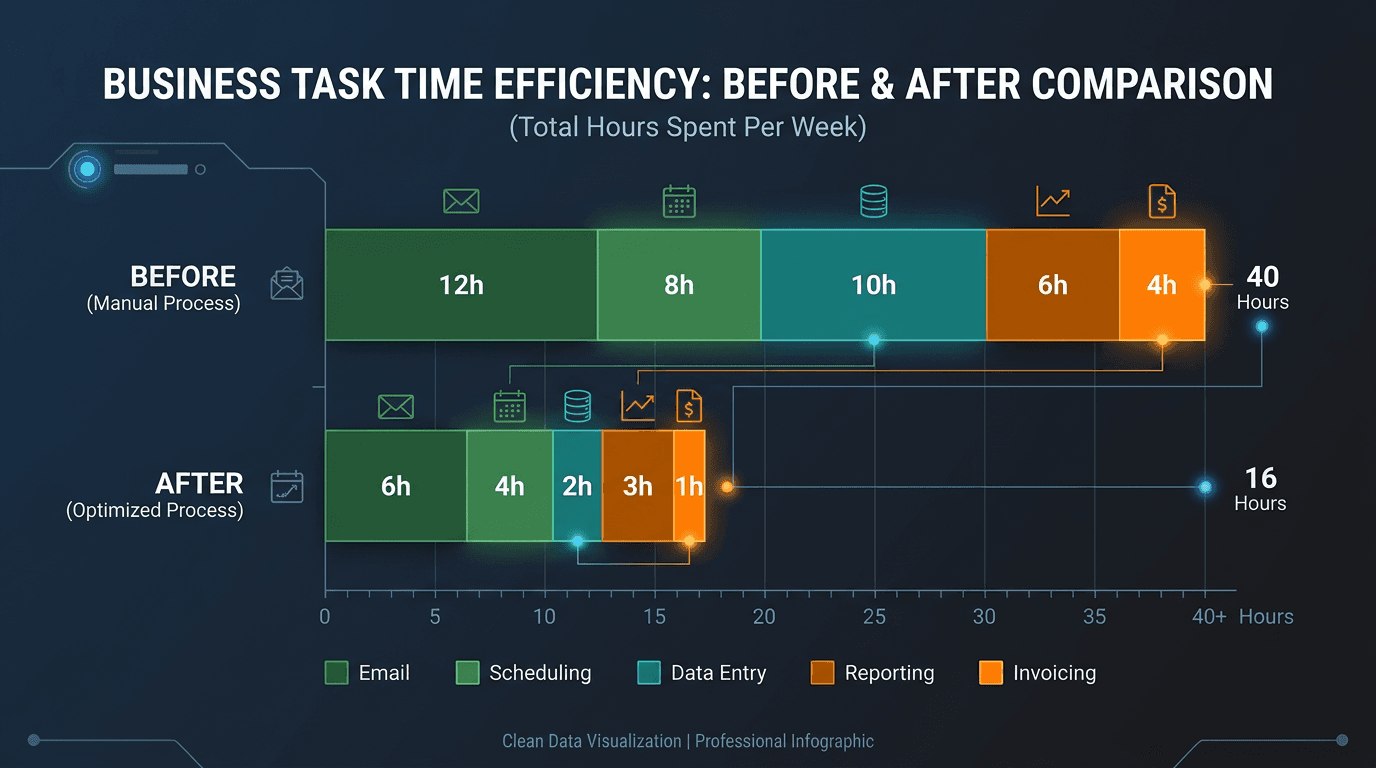
Average hours per week spent on automatable tasks by small business owners.
The 10 Tasks AI Automates Best for Small Businesses
The best AI automations are boring. They don’t make headlines. They just quietly save hours every week while you focus on the things that actually matter. Here are the ten tasks where AI delivers the fastest, most reliable time savings for small businesses:
1. Email Management & Responses
Today: You scan 80+ emails a day, draft responses, forward to the right person, and flag follow-ups manually. With AI: Routine replies are drafted automatically. Priority emails surface to the top. Low-value messages get archived without you lifting a finger. Typical savings: 3–5 hours/week.
2. Scheduling & Calendar Management
Today: Five-message email chains to book one meeting. With AI: A scheduling assistant checks availability, proposes times, and confirms—all without you in the loop. Typical savings: 2–3 hours/week.
3. Data Entry & Spreadsheet Updates
Today: Copy-paste from invoices, receipts, and forms into spreadsheets or your CRM. With AI: Automation pulls data directly from source documents and populates your systems. Zero typos. Typical savings: 3–4 hours/week.
4. Invoice & Billing Processing
Today: Create invoices, chase late payments, reconcile billing records. With AI: Invoices generate automatically from project data. Follow-up reminders go out on schedule. Payment records sync to your books. Typical savings: 1–2 hours/week.
5. Social Media Content Creation
Today: Stare at a blank screen, write three posts, find images, schedule them one at a time. With AI: Generate a week’s worth of on-brand posts in minutes. Schedule across platforms in one click. Typical savings: 2–3 hours/week.
6. Report Generation & Formatting
Today: Pull data from three systems, paste into a template, format charts, email it out. With AI: Reports build themselves on a schedule with live data, formatted and delivered to the right people automatically. Typical savings: 2–3 hours/week.
7. Customer Inquiry Responses
Today: Answer the same 15 questions over and over via email, chat, and phone. With AI: An AI assistant handles FAQs instantly, 24/7, and escalates only the questions that need a human. Typical savings: 3–4 hours/week.
8. Lead Follow-Up & Qualification
Today: Leads sit in your inbox for days. You forget to follow up. Deals go cold. With AI: Every lead gets a personalized follow-up within minutes. Qualification questions happen automatically. You only talk to people ready to buy. Typical savings: 2–3 hours/week.
9. Document Drafting & Formatting
Today: Open a template, customize it, fix formatting, save as PDF, email it. With AI: Proposals, contracts, and reports generate from your notes in seconds. Formatting is consistent every time. Typical savings: 2–3 hours/week.
10. Research & Competitive Analysis
Today: Open 20 tabs, skim articles, try to synthesize what matters. With AI: Get a summary of competitor pricing, market trends, or customer sentiment in minutes instead of hours. Typical savings: 2–3 hours/week.
How to Find Your First Automation Win
Here’s the simplest way to find your first automation: try the “Monday morning” test. Think about the first thing you or your team dreads when the week starts. The task everyone puts off. The one that makes people groan in the morning standup. That’s your starting point.
You want to look for the sweet spot: the task that eats the most hours but has the lowest complexity. Data entry is the classic example. It takes hours, requires no creative judgment, and follows the same steps every time. That’s a perfect first automation. Scheduling is another one—it feels like nothing, but add it up over a month and it’s a full workday gone.
Don’t try to automate everything at once. That’s how businesses stall out. They buy five tools, configure none of them properly, and decide “AI doesn’t work.” Instead, pick one task. Get it running. See the time come back. That single win creates confidence—and momentum—for the next one.
According to a 2024 Salesforce survey, 52% of business owners say they don’t know where to start with AI. The answer is simpler than they think: start with one task. The one that wastes the most time. Automate that. Then pick the next one.

Start with high-hours, low-complexity tasks for the fastest wins.
What 10 Extra Hours Per Week Actually Looks Like
Ten hours a week sounds abstract until you do the math. At $100/hour, that’s $1,000 a week in recovered capacity. Over 50 working weeks, it’s $50,000 a year—not in new revenue, but in time you already have that you’re currently burning on work a machine can do.
Revenue impact: Those 10 hours aren’t just saved—they’re freed up for work that generates income. More sales calls. More proposals sent. More time building relationships with your best customers. The real ROI of automation isn’t just the cost of the hours saved—it’s the revenue those hours produce when you redirect them.
Strategic work: Every business owner has a list of projects that “keep getting pushed.” A new service offering. A partnership that could double your revenue. A hiring plan that would let you scale. Those projects don’t happen because there’s no time. Ten hours a week changes that.
Personal time: Leave at 5pm instead of 7pm. Skip the Sunday catch-up. Take a real vacation without your laptop. This isn’t soft motivation—it’s the reason most people started their business in the first place.
Competitive edge: While you’re responding to customers in minutes with AI, your competitor is still doing it manually in hours. While your reports build themselves overnight, their office manager spends every Friday afternoon on them. Automation doesn’t just save time—it widens the gap between you and everyone else in your market.
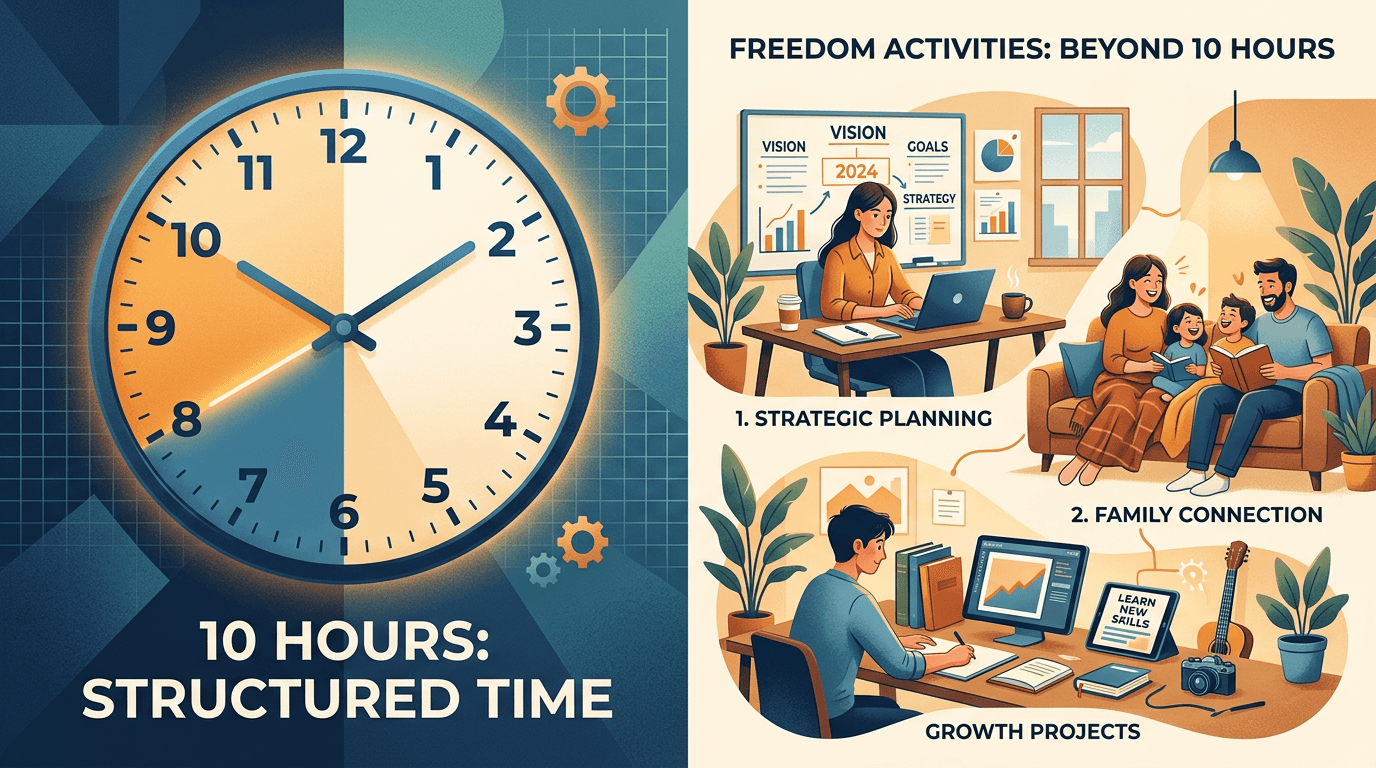
10 hours/week = $50,000+/year in recaptured capacity at $100/hour.
Ready to Get Those Hours Back?
Use the calculator above to see your specific savings. Then take the next step with one of these free tools:
Want to talk through your results? Email us directly and we’ll walk through your automation roadmap.