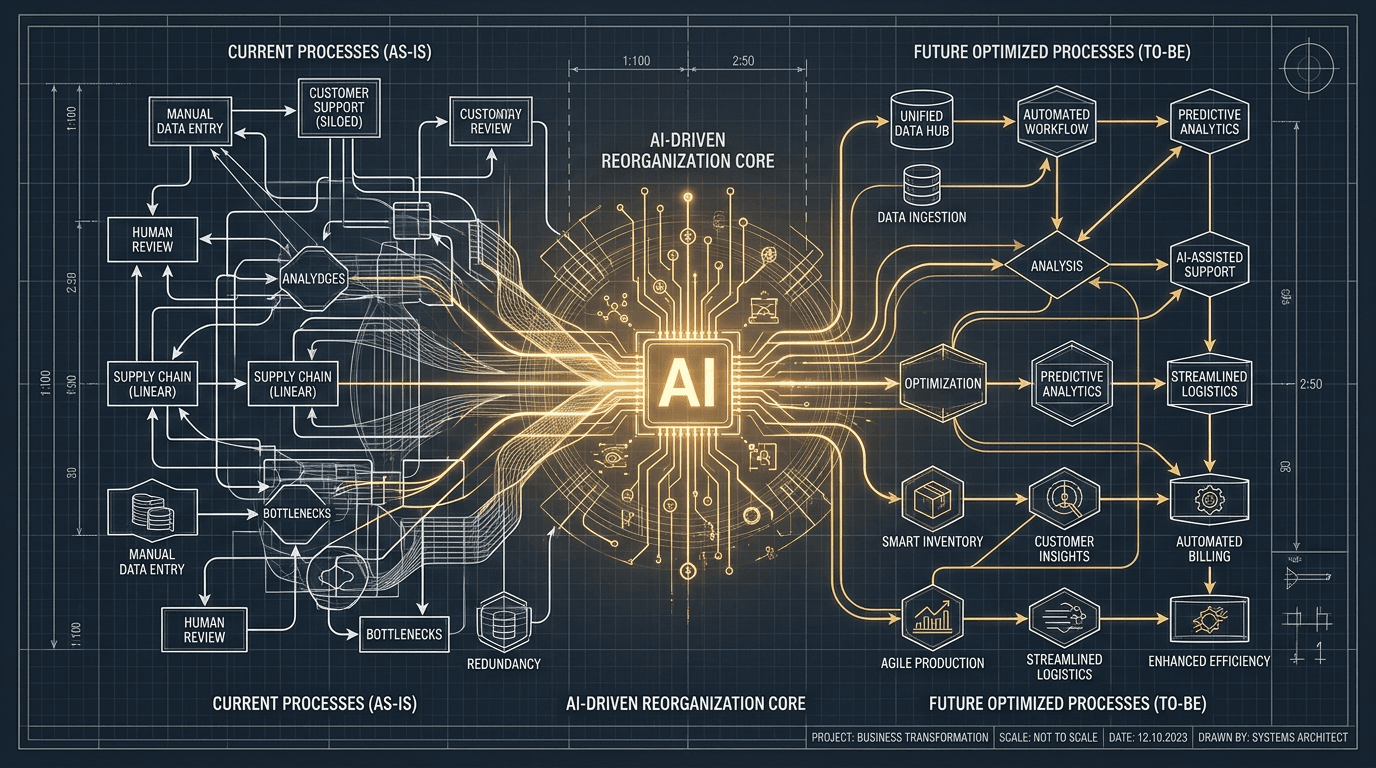
The Map Before the Territory
Process redesign without accurate current-state documentation is guesswork. Organizations consistently overestimate how standardized their processes are and underestimate the workarounds, exceptions, and tribal knowledge that keep operations running. Our mapping methodology captures processes as they actually operate, not as they are described in policy manuals. This honest baseline is the foundation for identifying where AI can add the most value and where process standardization must happen before automation is viable.
Workflow Documentation
We produce detailed process maps using BPMN notation showing every step, decision point, branching path, and handoff in your core workflows. Maps include system interactions, data flows, and human touchpoints.
Workaround Discovery
Every organization has informal processes that exist because the official process does not work. We document these workarounds because they reveal genuine needs and often contain innovation that should be formalized.
Cycle Time Measurement
We measure end-to-end process duration, distinguishing between active work time and wait time. This reveals that most processes spend 80% of their duration waiting: for approvals, information, or the next available resource.
Touchpoint Analysis
Every point where a human interacts with the process is cataloged: data entry, review, approval, exception handling, and communication. Each touchpoint is evaluated as a potential automation or augmentation target.
Mapping Methodology
Observe
Shadow process participants
Interview
Capture perspectives by role
Document
Create BPMN process maps
Measure
Collect timing and volume data
Validate
Review maps with participants
Observe
Shadow process participants
Interview
Capture perspectives by role
Document
Create BPMN process maps
Measure
Collect timing and volume data
Validate
Review maps with participants
Current State Assessment
Mapping Techniques
We use multiple techniques to ensure process maps reflect reality rather than aspirational descriptions.
Process shadowing. We sit with the people performing the work and observe the actual steps they take. This reveals clicks, copy-paste operations, system switches, and micro-tasks that interview-based methods miss. A process described as "enter the order" in an interview reveals itself as 14 distinct steps across three systems during observation.
Variant analysis. No process runs the same way every time. We identify the major variants: by customer type, product category, exception case, or geographic region. Each variant is mapped separately becauseautomation solutions may differ by variant.
System log analysis. Where available, we supplement observation with system logs that show actual transaction volumes, processing times, and error frequencies. Log data provides statistical rigor that small-sample observation cannot achieve.
Using the Process Map
The completed process map serves multiple purposes: it is the input for AI opportunity identification, the baseline for measuring improvement after automation, and a communication tool for aligning stakeholders on the scope and impact of proposed changes. We deliver maps in formats that integrate with your existing documentation systems.
Contact us at ben@oakenai.tech to map your processes before redesigning them.