Integration Types
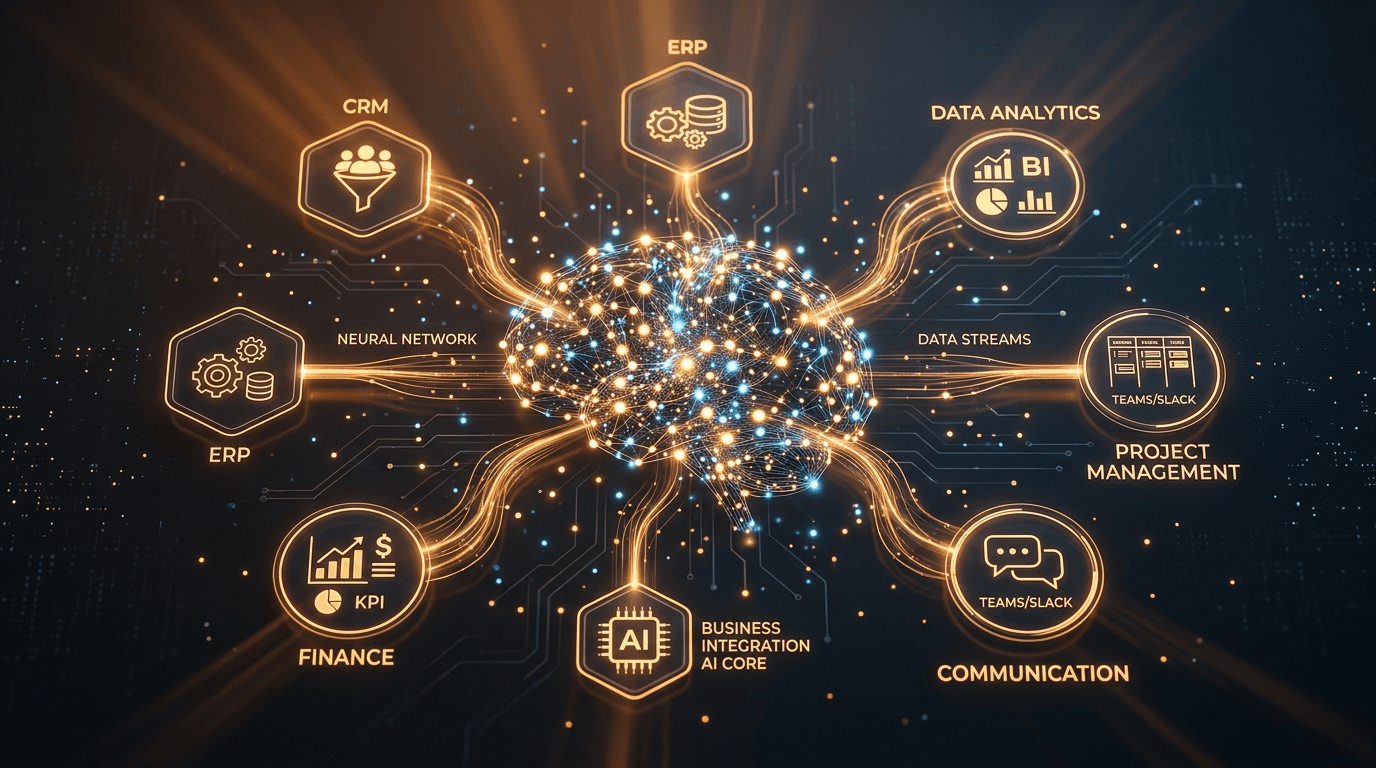
Language models are powerful in isolation, but they become transformative when connected to your business systems. The difference between a chatbot demo and a production tool is integration: the ability to read from your databases, write to your CRM, search your documents, and take actions in the tools your team already uses.
CRM Automation
AI that enriches lead records, drafts follow-up emails, scores opportunities based on conversation history, and updates pipeline stages. Works with Salesforce, HubSpot, Pipedrive, and custom CRMs.
Intelligent Search
Semantic search across your internal knowledge base, documentation, Slack history, and file storage. Employees ask questions in plain language and get accurate answers with source citations.
Custom Chatbots
Customer-facing assistants that answer questions using your actual product data, pricing, and policies. Grounded in your documentation, not generic training data, with graceful handoff to human agents.
AI Assistants
Internal tools that help your team draft proposals, analyze contracts, summarize meetings, and generate reports. Each assistant is scoped to a specific role and has access only to relevant data.
Integration Approach
Connect
APIs, databases, existing tools
Read-Only
AI analyzes your real data
Human Loop
AI proposes, humans confirm
Autonomous
Trusted operations run on their own
Connect
APIs, databases, existing tools
Read-Only
AI analyzes your real data
Human Loop
AI proposes, humans confirm
Autonomous
Trusted operations run on their own
AI Integration Services
Our Approach
We do not start with the model. We start with the problem. Most AI integration projects fail because they begin with "let's add AI" instead of "let's fix this specific bottleneck." We identify the exact point in your workflow where intelligence is missing, then we build the minimum integration needed to solve it.
Every integration follows a three-phase pattern. First, we build a read-only prototype that shows AI analyzing your real data without making any changes. Your team validates the outputs against their own judgment. Second, we add write capabilities with human-in-the-loop approval: the AI proposes actions, a person confirms them. Third, once trust is established, we enable autonomous operation for well-understood scenarios while keeping human review for edge cases.
This phased approach means you never wake up to find an AI has made hundreds of bad decisions overnight. Trust is built incrementally, and autonomy is earned through demonstrated accuracy.
Technical Stack
We are model-agnostic. The right model depends on your requirements for accuracy, latency, cost, and data privacy. For most business applications, we work with frontier models from leading providers and open-weight models for on-premise deployments where data cannot leave your network.
Integrations are built using standard APIs and webhooks. We connect to your systems through their existing interfaces: REST APIs, GraphQL endpoints, database connections, and OAuth flows. No custom agents running on your servers with elevated permissions. No black-box middleware you cannot inspect.
For knowledge-grounded applications like internal search and chatbots, we use retrieval-augmented generation (RAG) with vector databases. Your documents are embedded, indexed, and searched semantically so the AI's responses are based on your actual content rather than its general training data.
Everything we build includes structured logging, cost tracking, and performance monitoring. You can see exactly which API calls are being made, how much they cost, how long they take, and what outputs they produce. No surprises on your monthly invoice.
What Changes
The goal is not to replace your team. It is to remove the low-value work that prevents them from doing what they are actually good at. When a salesperson spends 30 minutes writing a follow-up email, that is 30 minutes they are not spending in conversations. When an analyst spends a day compiling a report, that is a day they are not spending on analysis.
After an integration goes live, the typical pattern is this: your team is skeptical for the first week, cautiously optimistic by week two, and asking for more integrations by week four. The technology fades into the background and becomes just another tool in the stack. That is the right outcome.
If you have a specific workflow you think could benefit from AI, or if you are unsure where to start, get in touch at ben@oakenai.tech. We will walk through your systems and give you an honest assessment of where AI adds real value and where it does not.